Enquire Online Now

Mobile access tower incidents are a preventable cause of serious injury on UK worksites, and one that health and safety professionals consistently flag as under-addressed. The structure is stable when built correctly. The problem is that far too many operatives climb towers they assembled without ever receiving formal training or holding a valid certificate. The gap between “I’ve done it before” and “I’m certified to do it” is where accidents happen, and where employers find themselves exposed under UK health and safety law.
This article covers exactly what PASMA certification is, who needs it, what the course involves, what it costs, and how to keep it current. The advice here comes from direct experience in accredited vocational training. At 2 Start Training, we deliver PASMA courses regularly, so the practical detail below reflects what actually happens before, during, and after training, not a generic summary pulled from a website.
What PASMA certification actually proves
PASMA stands for the Prefabricated Access Suppliers’ and Manufacturers’ Association, the UK’s leading not-for-profit trade body for the mobile access tower industry. When someone holds PASMA certification, it confirms they have been assessed as competent to safely assemble, alter, move, inspect, and dismantle a mobile scaffold tower in line with the PASMA Code of Practice. That is a specific and meaningful standard, not a general working-at-height awareness certificate.
One point worth clarifying: PASMA itself does not deliver training. It approves training centres and instructors, sets the curriculum and assessment criteria, and maintains the certification system. The approved training centre issues the certificate and card once a candidate passes both components. If a provider cannot demonstrate current PASMA-approved status, any certificate they issue will not be nationally recognised.
The PASMA card and what it confirms
Successful candidates receive a PASMA card, the portable, day-to-day site credential that most operatives carry alongside their other site documentation. Each card carries a unique reference number, the holder’s name, the qualifications gained, and an expiry date. For those who prefer a digital option, the TowerSure app allows the same card to be stored on a phone or tablet (see the changes to TowerSure virtual cards). Site managers can verify any card, physical or digital, instantly using PASMA’s “Check a Card” tool on PASMA.co.uk, which confirms both the card’s validity and the specific tower categories the holder is qualified to work with.
Certificate versus card: understanding the difference
Candidates receive both a certificate of competence (the formal document) and the PASMA card (the practical site credential). Both carry the same expiry date and are issued by the training centre on the day of successful assessment, not posted later by PASMA centrally. When employers are deciding what to request from workers as proof of competence, either document is acceptable, though the card is easier to carry and quicker to verify on site.
Who is legally required to hold a valid PASMA card
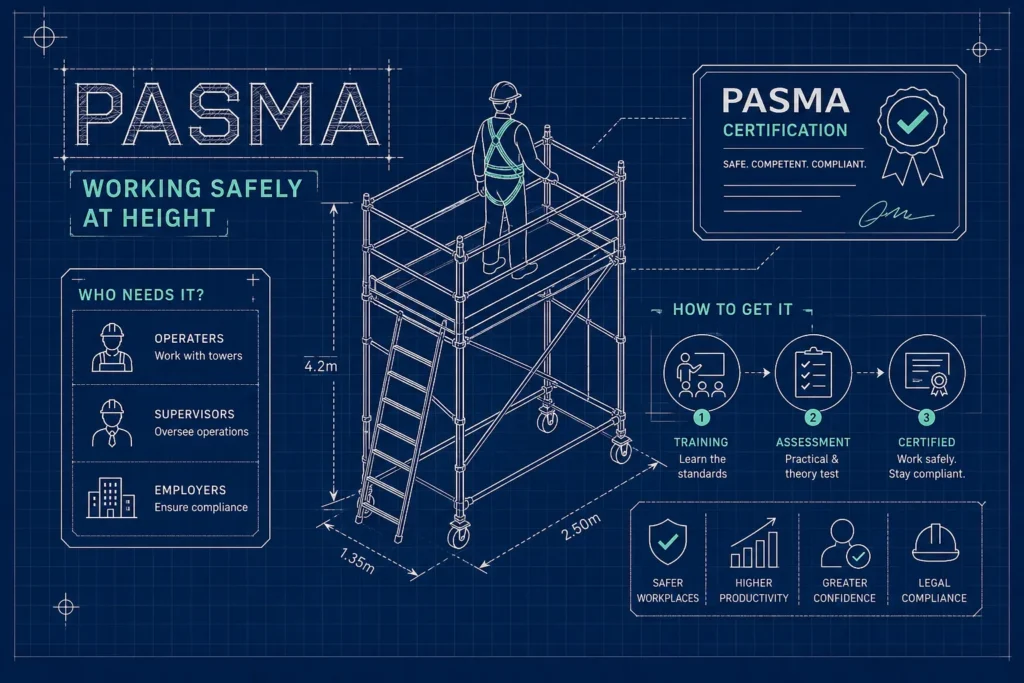
The Work at Height Regulations 2005 place a clear duty on employers to ensure that anyone working at height is competent to do so. For mobile access tower work specifically, PASMA certification is the widely accepted standard for demonstrating that competence. The Regulations extend that requirement beyond the person physically on the tower: those who plan, inspect, supervise, and manage tower use must also be competent. Holding an expired card does not satisfy this requirement, and accepting one as proof of competence is a compliance risk for any employer.
Roles and industries where a PASMA card is typically required
Sectors where valid certification is commonly required include construction, facilities management, events and staging, warehousing, retail fit-out, and building maintenance. Many principal contractors and site safety managers treat a current PASMA card as a condition of site entry for tower work, regardless of what an individual’s direct employer demands. In practice, arriving on site without valid certification when tower work is involved is likely to mean you cannot proceed, which is a disruption no operative or employer wants.
Employer responsibilities under UK health and safety law
Employers are required to verify competence before allowing anyone to use a mobile access tower on their behalf. If an unqualified operative is injured, the absence of verifiable training records is treated as a serious finding by HSE inspectors, and the employer’s liability exposure is significant. PASMA certification is a nationally recognised standard issued by an approved centre, with a verification tool that takes seconds to use, making it the most straightforward way for a business to demonstrate due diligence. Employers running compliance audits should check card validity through the official tool rather than relying on a visual inspection alone, since a card can look current while already having passed its expiry date (guidance on common card-checking errors can be found in industry commentary such as Are you checking PASMA cards properly?). For a concise explanation of the employer and employee obligations, see our article Why do you need PASMA Training?.
What the course covers and how you are assessed
A standard PASMA mobile access tower course runs for one full day and combines classroom instruction with hands-on practical work. The curriculum covers health and safety legislation (including the Work at Height Regulations 2005), tower components and types, hazard recognition, stability rules, load awareness, correct use of PPE, and safe assembly methods including the 3T (Through the Trapdoor) and AGR (Advanced Guardrail) techniques. For a straightforward overview of the qualification and what it covers, see What is PASMA training?.
The theory test: format and pass mark
The written assessment is a multiple-choice knowledge test with an official pass mark of 24 out of 30. Candidates who do not reach this mark before moving to the practical element receive guidance from the instructor before retesting. The theory component is not a box-ticking exercise; it ensures operatives can make informed, independent decisions on site when conditions change or something does not look right during assembly.
Practical assessment: what you will be asked to demonstrate
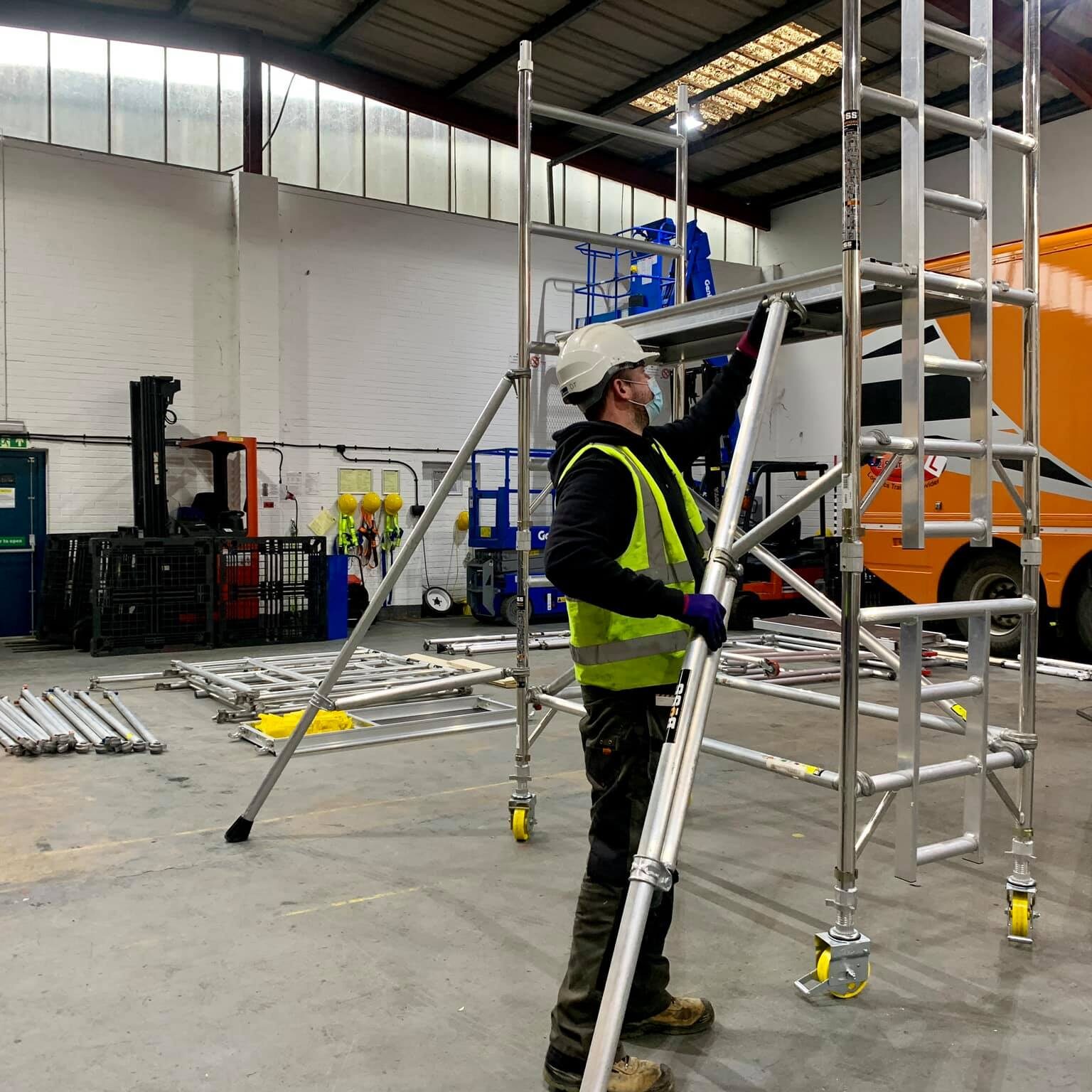
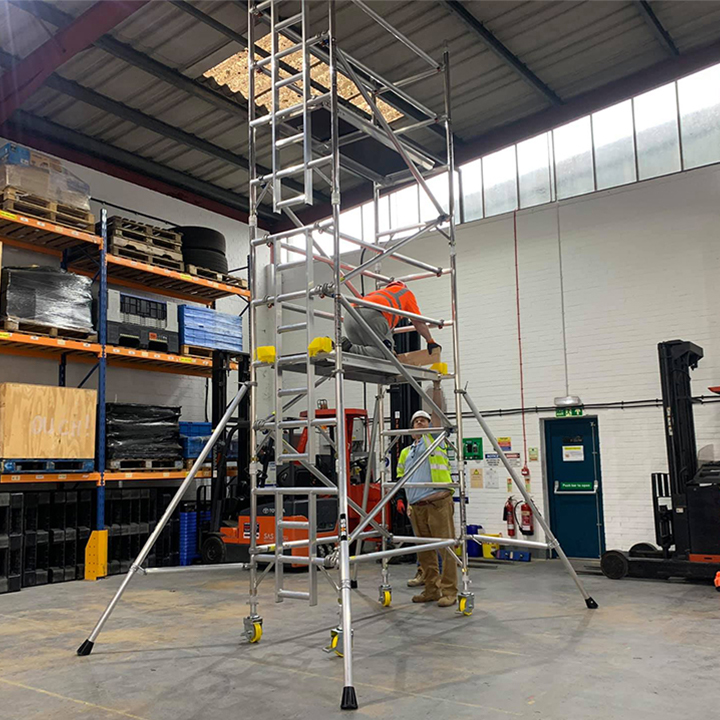
The hands-on element requires delegates to assemble a mobile access tower from scratch, demonstrate safe relocation of the tower, carry out a component inspection, and complete the relevant tagging documentation. The assessor is observing method, sequencing, and safety behaviour throughout, not speed. Candidates who pass both components receive their certificate and card on the same day, ready for use on site immediately.
Typical costs and what to expect on the day
A standard one-day PASMA course in the UK currently sits in the £200 to £285 per delegate range, plus VAT, depending on the provider and course variant. The most common format is a full classroom day covering the Towers for Users qualification. A blended option is also available from some providers: roughly 2.5 hours of classroom learning, followed by a half-day on-site practical session. For employers with larger groups, on-site delivery brings the trainer to your premises and can reduce the per-head cost when the numbers justify it.
Comparing delivery formats: classroom, blended, and on-site
Classroom delivery suits individuals and small groups who benefit from a consistent, controlled environment with qualified instructor oversight throughout the day. The blended route works for operatives who can manage the theory independently and need flexibility around their working schedule. On-site delivery is the practical choice for employers who want minimal disruption to operations and already have suitable space and equipment available at their premises. The right format depends on your situation; the qualification outcome and the assessment standard are the same, whichever route you take.
What you receive when you pass
On passing both assessments, candidates leave with a PASMA certificate of competence and a PASMA card, both issued on the day by the training centre. The card is valid for five years and is accepted across UK sites as proof of competence for mobile access tower work. There is no waiting period and no separate application to PASMA; the card is live from the moment it is issued.
How to find and verify a PASMA approved training centre
The only reliable method for confirming a provider holds current PASMA approval is the official “Find a Training Centre” search tool on PASMA.co.uk. This database is live and filters results to show only centres with active accreditation. A provider who claims to offer PASMA-accredited training but does not appear in that directory is not approved, and any certificate they issue will not be nationally recognised on site. Here at 2 Start, we are PASMA approved!
Warning signs of non-approved providers
When assessing a provider, watch out for these common red flags:
- No PASMA logo visible on marketing materials or the training centre’s premisesAn inability to produce a PASMA certificate rather than the provider’s own branded documentPricing that excludes the certification fee without making this clear upfrontNo PASMA-approved instructor present for the practical element
PASMA’s own guidance on selecting an approved centre covers several of these checks. If any of these issues arise, do not book. An unrecognised certificate wastes the delegate’s time and puts the employer back at square one for compliance.
Why training environment quality matters for hands-on courses
The practical assessment requires adequate space, correct and well-maintained equipment, and a setup that replicates real working conditions. Providers who deliver this element in car parks, cramped storage areas, or with ageing tower components put delegates at a disadvantage both for passing the assessment and for retaining the skills they need on site. A dedicated facility set up specifically for mobile access tower training, with current-generation equipment and instructors who deliver regularly, provides a meaningfully different learning environment from one improvised around other activities.
How long your certificate lasts and when to book a refresher
A PASMA certificate is valid for five years from the date of issue. PASMA’s guidance is clear: renewal must happen before the expiry date, not after. Once a card has expired, it is no longer valid as proof of competence. Depending on how long the gap is, an expired cardholder may be required to complete a full course rather than a shorter refresher session, which makes late renewal more disruptive and potentially more expensive than it needed to be.
What the refresher process involves
A PASMA refresher course is not a brief recap. Operatives go through the same written and practical assessment structure as new candidates, with updated guidance and any changes to the Code of Practice incorporated into the content. Booking well before your card expires avoids the situation where a worker is temporarily unable to operate on site while waiting for the next available course date. As a practical recommendation, four to six weeks’ lead time before expiry is a sensible planning window, particularly for employers managing multiple cards across a team.
Verifying your own card or a colleague’s card
PASMA’s “Check a Card” tool on PASMA.co.uk allows anyone to confirm validity in seconds. Employers running periodic compliance audits should make this check routine rather than relying on visual inspection of the physical card alone. For individuals, checking your own expiry date before starting a new contract or project means you will not be caught out on arrival at a site that requires a valid card as a condition of entry.
Getting your PASMA certification sorted
Before booking, confirm whether your role requires a valid PASMA card, verify any existing certificate using the official tool, and choose an approved training centre with the facilities and instructors to deliver the practical element properly. The certification process is a single day’s commitment with a five-year return in terms of site access and compliance.
For anyone in the south of England looking to book an accredited PASMA course, 2 Start Training delivers training in a dedicated warehouse environment with experienced instructors and a clear focus on getting delegates competent and certified on the first attempt. Check course availability and secure your place at Everything you need to know about PASMA Training.